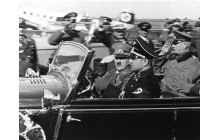
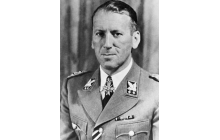
Herman Göring i vidneskranken
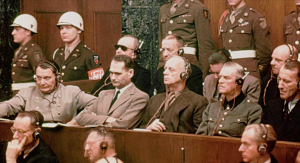
Der varen markant forskel på den Hermann Göring, amerikanerne fik fat i i maj 1945 og så manden, da han trådte frem for Den Internationale Krigsforbryderdomstol i marts 1946. Rigsmarskallen, hvis højde var 1.70, var særdeles overvægtig - mellem 120 - 127 kg - og han havde haft et voldsomt medicinmisbrug. Han spiste dagligt mellem 40 og 60 parakodein piller, og i bagagen medbragte han 20.000 af disse piller. De amerikanske læger påbegyndte en langsom nedtrapning, så Göring kom ud på den anden side i fin form. En streng diæt medførte, at han tabte 30 kilo. Det var en mand, der både fysisk og psykisk var i fin form. Én som skabte store udfordringer for krigsforbryderdomstolen.
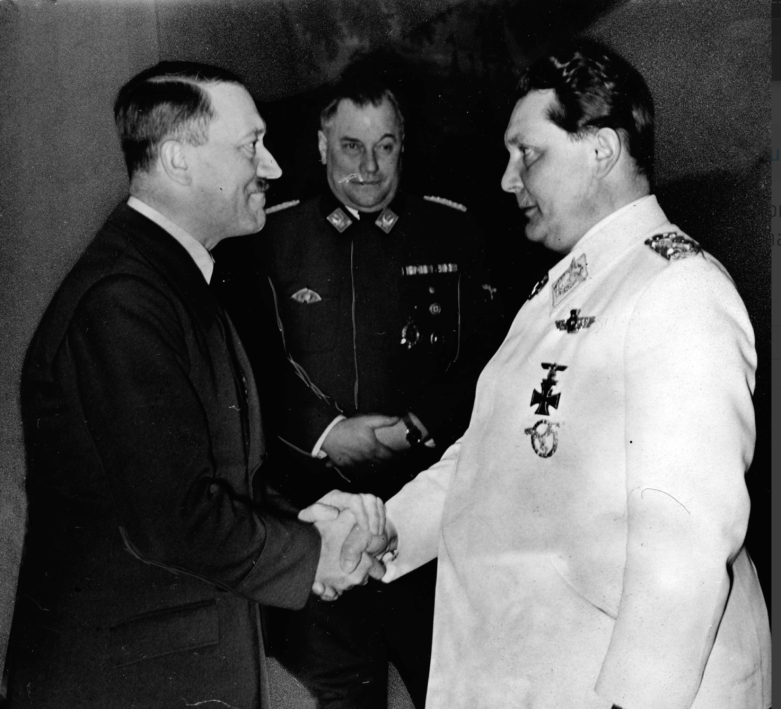 En tilsyneladende glad Adolf Hitler lykønsker chefen for Luftwaffe, Hermann Göring, på dennes fødselsdag i januar 1940. Den uniformsglade Göring optræder her i en af sine egne kreationer. Det var en stor dag for ”den anden mand i Tyskland” - sådan omtalte han gerne sig selv. Foto: HPN
Uddrag af retsbogen den 18. marts 1946.
Læg mærke til hvor langt ned i detaljerne, Göring kan gå. Nu fejlede hans hukommelse absolut ikke noget.
[Turning to the witness.] Witness, at the Munich conferences Hitler, it is alleged, put the following question: "What is to happen if the Czechs are not in agreement with our occupation of the Sudetenland?" Thereupon Daladier answered, "Then we will force them." Is that correct?
Goering: This question was actually broached by the Fuehrer during the discussion. Premier Daladier said, in substance, whether with the same words or not, somethihg which corresponds to the sense of this statement. As far as I can still remember fairly exactly, he emphasized that now a decision in that direction had been reached by the great powers for the purpose of maintaining peace, and this peace must not be threatened anew by Czechoslovakia's refusal, otherwise neither England nor France would feel themselves in any way in duty bound to help, if Czechoslovakia did not follow this advice.
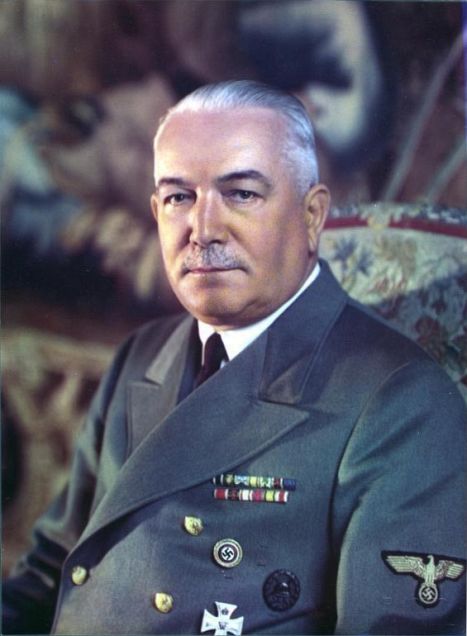 Billedet af von Neurath efter han havde fået Partiemblenet af Adolf Hitler
DR. KRAUS: Witness, how long have you known Herr Von Neurath?
Goering: As far as I recall I saw Herr Von Neurath very briefly when he was the German Ambassador to Denmark in 1919, but only for a short time. Later I met him again just before the seizure of power and spoke to him very briefly, I believe; my closer relationship and acquaintance begins from the time after the seizure of power.
DR. KRAUS: Did you have any closer knowledge of his activities as Ambassador in London?
Goering: That is correct. I did know about his work before, because even in former times, that is in 1931 and 1932, before Herr Von Neurath became Foreign Minister, in discussions about the possible formation of a cabinet, we also considered the name of Herr Von Neurath as a candidate, even though he did not belong to the Party. As a basic consideration in this connection his very position as Ambassador to England played the main role, since we, that is, Hitler as well as I, were of the opinion that Herr Von Neurath's relations as Ambassador to the English Government were very good and that Herr Von Neurath could be an important factor in this field -- that of good relations with England -- which was a basic consideration in the Fuehrer's foreign policy.
DR. KRAUS: Then I may assume that Herr Von Neurath had pursued a policy of peace and understanding in London?
Goering: Yes, you can assume that exactly.
DR. KRAUS: Yes; and can you tell me if, beyond that, Herr Von Neurath made efforts in his capacity as Foreign Minister as well, to continue this policy of peace and understanding?
Goering: When Reich President Von Hindenburg made it a condition, which I have already mentioned, that Herr Von Neurath should become Foreign Minister, the Fuehrer was in full agreement with this condition, because he saw that the task of establishing good relations with England and the West was in good hands. Herr Von Neurath always made every effort in this direction.
DR. KRAUS: I should like to deal with another series of questions.
Were you present at the meeting of the Reich Cabinet on 30 January 1937, during which Hitler gave the Golden Party Emblem to those members of the Cabinet who were not members of the Party, among them also Herr Von Neurath?
Goering: Yes, I was present.
DR. KRAUS: And do you know that Hitler declared on this occasion that it was purely a distinction such as the conferring of an order, and that the gentlemen concerned did not thereby become Party members and had no obligations toward the Party?
Goering: I would not put it just that way. The Fuehrer was speaking spontaneously, since it was the anniversary of the seizure of power, and he said it was his intention in this way to show his confidence in those members of the Reich Cabinet who did not belong to the Party. I believe he used the words, "I should like to ask them to accept this Party Emblem." He said at the time that in his opinion this was a decoration and that he intended, as he actually did later, to develop additional grades of this decoration. The first grade of this decoration was to be the Golden Party Emblem. Then, on the spur of the moment, he stepped up to the various ministers and handed them this emblem. In doing so he neither emphasized that they were thereby to consider themselves members of the Party, nor did he emphasize that they were not Party members.
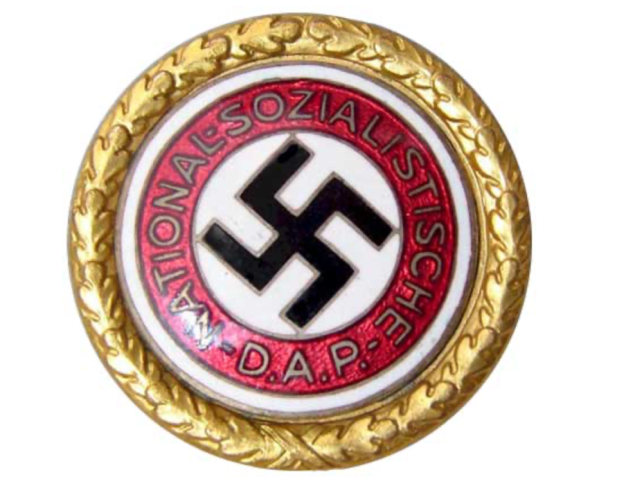
When he came to Herr Von Eltz-Rubenach, this gentleman asked whether he was thereby obliged to stand for the partly anti-clerical tendency of certain Party cixcles, or something to that effect. The Fuehrer hesitated for a minute and said, "Then you do not wish to accept it?" Whereupon Herr Von Eltz said, "I do not wish to say that. I just wish to make a certain reservation." The Fuehrer was taken aback; immediately he turned around and left the cabinet room.
In this connection it is not correct, as has been maintained, that Herr Von Eltz resigned voluntarily because of this. I followed the Fuehrer immediately and felt, as did all the other gentlemen, that this incident was an insult to the Fuehrer, since membership in the Party had not been mentioned at all. In addition, and this is very important, the Fuehrer was already considering a plan to divide the Ministry of Transport and to re-establish the old Post Ministry and to put the railroad expert Dorpmuller into the Ministry of Transport. The Fuehrer had told me this previously and, as he had left it to me to tell Von Eltz about it gradually, in a diplomatic way, I took this opportunity and went to Herr Von Eltz and said: "Your behavior was impossible, and I think the only thing for you to do is to resign at once." He said, "I did not mean it like that," and he was not willing to hand in his resignation right away. I then asked him abruptly to do so by that evening. I also sent State Secretary Meissner to him to say it would be advisable for him to leave the Cabinet,and hand in his resignation immediately, especially in view of -- and then I gave the explanations concerning the post and railroads as I have just given them.
That was what happened at that conference with regard to the Golden Party Emblem.
Erik Ingemann Sørensen
[Historie-online.dk, den 18. marts 2026]